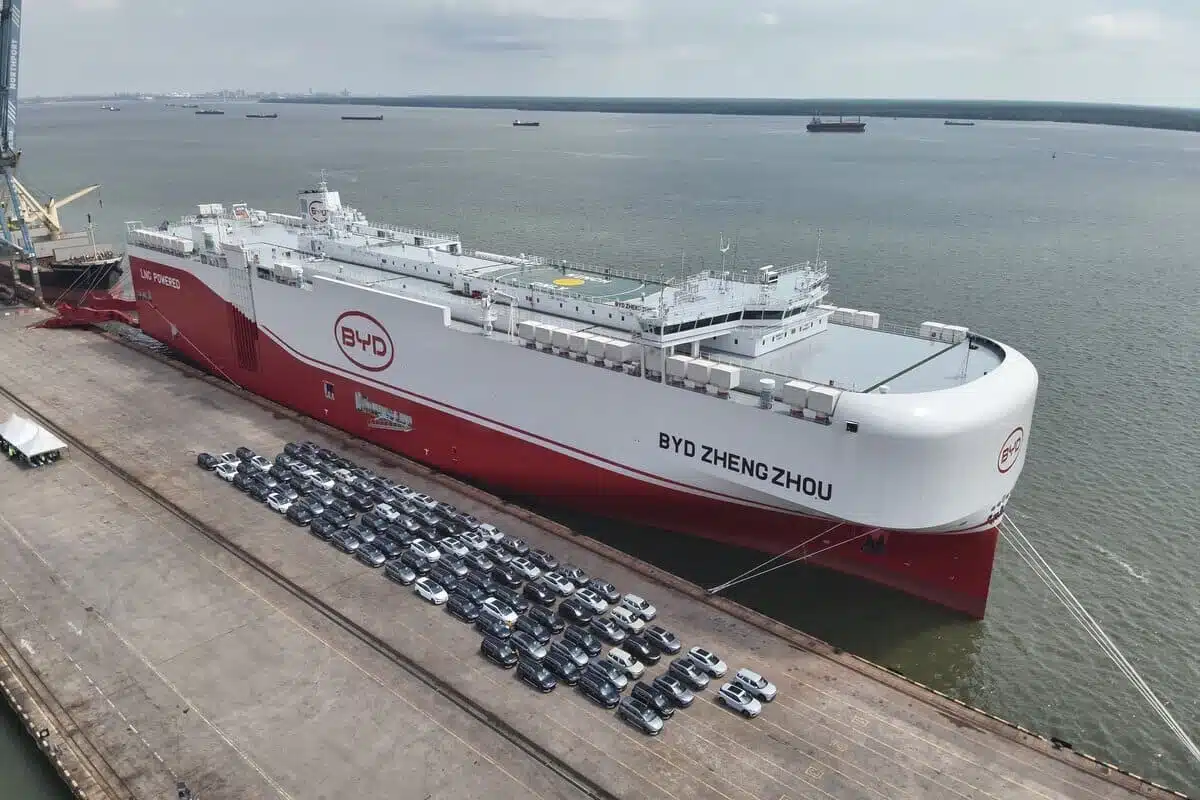


NORTHPORT, PORT KLANG, 6 August 2025 – In a milestone that strengthens Malaysia’s position in the global electric vehicle (EV) supply chain, BYD Malaysia and Sime Motors, the official distributor of BYD vehicles in Malaysia, today announced the arrival of the BYD-owned carrier vessel BYD Zhengzhou carrying fully-built BYD vehicles for local delivery.
The roll-on/roll-off (RORO) vessel, with a capacity of 7,000 units, marked its first journey to Southeast Asia with scheduled deliveries to the Philippines, Indonesia, and Singapore. After docking at Northport, Port Klang yesterday, the vessel will make its final regional stop in Thailand before returning to China.
BYD Zhengzhou
BYD Zhengzhou is the seventh vessel in BYD’s dedicated shipping fleet, underscoring the company’s logistics readiness and commitment to meeting the surging global demand for EVs. Operating its own purpose-built carriers allows BYD to maintain greater control over its supply chain, improving delivery stability and efficiency.Powered by Liquefied Natural Gas (LNG) dual-fuel propulsion technology, this next-generation ship reduces carbon emissions by up to 30% compared to conventional fuel-powered vessels.
Jeffrey Gan, Managing Director of Sime Motors, Southeast Asia, said:
“This is a significant milestone in our partnership with BYD, symbolising confidence in Malaysia’s role as a vital EV hub. With this enhanced regional supply chain, we can ensure shorter delivery times, providing better customer satisfaction and preparing for higher volumes as EV adoption accelerates.”
He added:
“We are building a dynamic ecosystem that covers retail, after-sales, and customer education to support the shift towards cleaner, smarter, and more sustainable mobility. This is just the beginning, with more innovations and strategic developments ahead.”
Eagle Zhao, Managing Director of BYD Malaysia Sdn Bhd, commented:
“The BYD Zhengzhou represents a key step in our global ambition and highlights Malaysia’s importance to our growth in Asia Pacific. By investing in our own shipping fleet, we can deliver EVs faster, more reliably, and at greater scale.”
The RORO method, in which vehicles are driven directly on and off the vessel, offers significant time and cost advantages compared to traditional container shipping. This efficiency enables BYD Malaysia and Sime Motors to fulfil customer orders more quickly, supported by a growing network of over 35 BYD outlets nationwide, with a target of 60 outlets by the end of 2026.
BYD operates its own roll-on/roll-off (Ro-Ro) car carrier fleet for several strategic reasons, all tied to cost, speed, and control over its rapidly growing EV export business. Here’s the breakdown:
Why does BYD operate their own carrier fleet?
1. Greater Control Over the Supply Chain
By owning vessels, BYD eliminates dependence on third-party shipping lines, which can be prone to delays, route changes, or capacity shortages.
This vertical integration means BYD controls when, where, and how vehicles are shipped—reducing uncertainty and aligning shipping schedules directly with production cycles.
2. Faster Delivery to Overseas Markets
Owning dedicated carriers means priority shipment for BYD vehicles, avoiding the wait times common in shared or chartered cargo space.
This ensures faster time-to-market, especially important for competitive EV markets like Southeast Asia, Europe, and South America.
3. Cost Efficiency & Long-Term Savings
Chartering ships for EV transport is expensive, especially during high-demand shipping seasons.
Over time, operating its own fleet lowers per-unit shipping costs, particularly when exporting at BYD’s scale (hundreds of thousands of EVs annually).
4. Flexibility to Serve New & Niche Markets
BYD can deploy vessels to emerging markets or secondary ports—such as Malaysia’s Subang, the Philippines, or smaller European terminals—without being limited by commercial shipping operators’ routes.
5. Reliability During Global Logistics Disruptions
Events like the pandemic, Red Sea shipping disruptions, and port congestion have shown the vulnerability of relying on external carriers.
BYD’s fleet provides resilience against such disruptions, helping maintain stable deliveries even when global shipping capacity is tight.
6. Branding & Market Presence
A BYD-branded vessel docking in a port is a powerful marketing statement, signalling the company’s scale, global reach, and commitment to that market.
It positions BYD alongside legacy automakers like Toyota or Volkswagen that also control parts of their shipping logistics.
7. Support for BYD’s Global Expansion Goals
China is now the world’s largest auto exporter, with BYD a major contributor. Having its own fleet is critical to sustaining this leadership.
BYD plans to expand production and sales in Southeast Asia, Europe, South America, and the Middle East—requiring predictable, large-scale logistics capacity.
BYD Car Carrier Fleet
There are currently a lineup of 7 BYD-owned roll-on/roll-off (Ro-Ro) car carriers, forming a growing fleet to support the global export of their electric vehicles. 6 of these vessels are BYD-Owned, while the BYD Explorer No. 1 is chartered.
| Ship Name | Ownership | Named After | Capacity |
|---|---|---|---|
| BYD Explorer No. 1 | Chartered | — | ~7,000 cars |
| BYD Hefei | BYD-owned | Hefei (production base) | 7,000 cars |
| BYD Changzhou | BYD-owned | Changzhou | 7,000 cars |
| BYD Shenzhen | BYD-owned | Shenzhen | 9,200 cars |
| BYD Changsha | BYD-owned | Changsha | 9,200 cars |
| BYD Xi’an | BYD-owned | Xi’an | 7,000+ cars |
| BYD Zhengzhou | BYD-owned | Zhengzhou | 7,000 cars |
BYD aims to complete a fleet of eight Ro-Ro vessels by 2026, each with dual-fuel (LNG and conventional) capability, reinforcing its vertical control over EV logistics and boosting global distribution efficiency.