

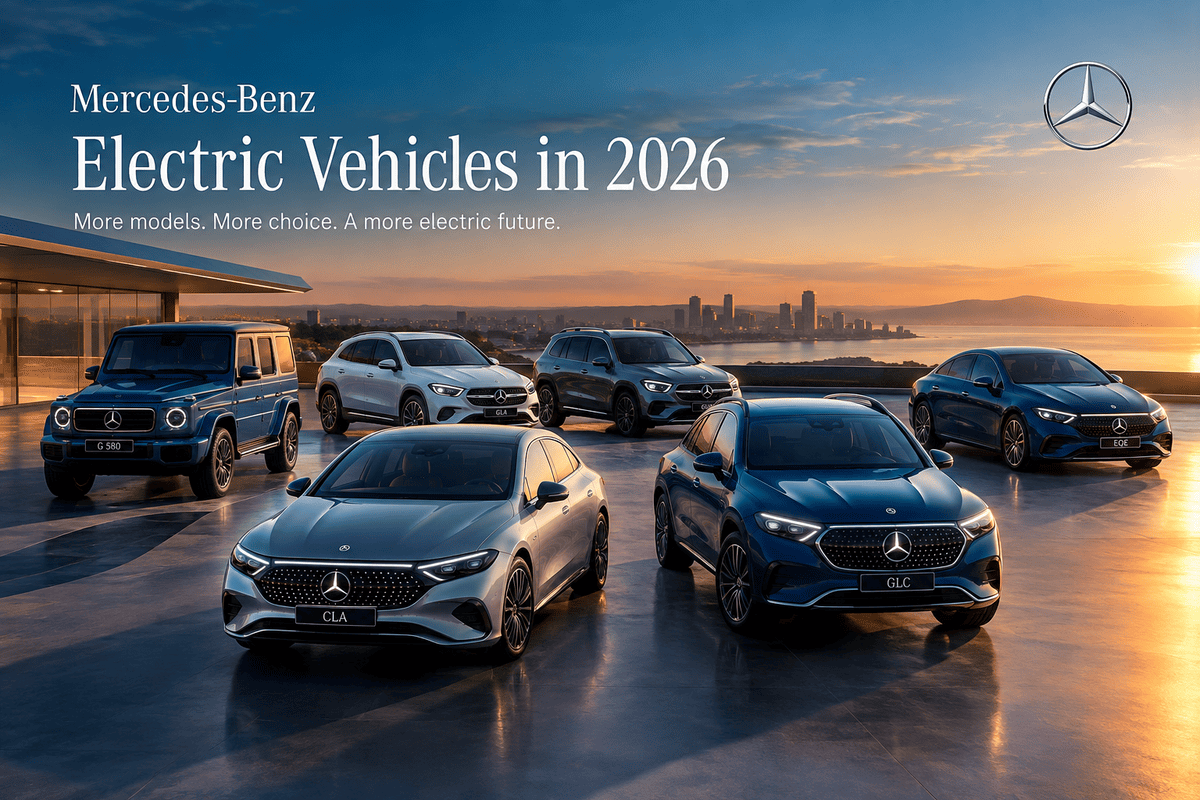
Mercedes-Benz is entering one of the most important stages of its electric vehicle transformation. With new electric versions of the CLA, C-Class, GLC and GLA joining the G-Class and established EQ models, the German automaker is taking a very different approach to its electric future.
There was a time when identifying a Mercedes-Benz electric vehicle was relatively easy. Look for the letters “EQ” and you would probably find one.
That is changing.
What stands out about Mercedes-Benz in 2026 is not simply the number of electric vehicles it has introduced. It is the way the company is integrating electric propulsion into its traditional model hierarchy.
The shift from a predominantly EQ-led identity towards electric versions of familiar names such as CLA, C-Class and GLC suggests that Mercedes-Benz sees electrification as becoming part of its mainstream product strategy rather than a separate branch of the business.
For consumers, that could be significant. Someone considering an electric Mercedes-Benz no longer necessarily has to choose between a familiar model and a completely different EQ product. The choice is increasingly between different powertrain technologies within the Mercedes-Benz family itself.
That may ultimately be a more important change than any individual range or charging figure.
In 2026, Mercedes-Benz is increasingly putting its electric technology into model names that have been familiar to drivers for decades. The CLA is electric. The C-Class is now electric. The GLC has entered a new electric generation, and the GLA is following the same path.
It is an important change in strategy.
Rather than asking customers to move away from the Mercedes-Benz models they already know, the company is effectively bringing electrification to the heart of its existing range.
At the same time, the EQE, EQS and their SUV derivatives remain part of the portfolio, while the unusual four-motor G 580 with EQ Technology has shown that an electric Mercedes can be just as distinctive as its petrol-powered predecessors.
For 2026, Mercedes-Benz says its passenger-car portfolio includes more than ten fully electric models. The company is also in the middle of its largest-ever product launch programme, with more than 40 new models planned between 2025 and 2027.
So, what does the Mercedes-Benz electric line-up look like in 2026?
Mercedes-Benz Electric Vehicles 2026
The new electric CLA: where the new generation begins
If there is one model that captures the direction Mercedes-Benz is taking, it is the new electric CLA.
The latest CLA is not simply an existing Mercedes-Benz sedan fitted with an electric motor. It is one of the first models built around the company’s new generation of electric technology.
The numbers are particularly interesting.
The CLA 250+ with EQ Technology can deliver up to 792 kilometres of WLTP range, while its 800-volt electrical system can add as much as 325 kilometres of range in around 10 minutes under suitable charging conditions.
Those figures put the CLA firmly into the conversation about long-distance electric driving.
But the technology underneath may ultimately be more significant than the headline range figure.
The CLA introduces Mercedes-Benz’s new MB.OS operating system, together with a new generation of MBUX and AI-powered functions. The idea is to turn the car into something that can evolve over time through software updates, rather than remaining largely unchanged after it leaves the factory.
That is becoming increasingly important as the automotive industry moves toward software-defined vehicles.
The new CLA has also received considerable international attention. It was named European Car of the Year 2026, after being evaluated by a jury of 59 automotive journalists from 23 countries.
There is also a CLA Shooting Brake, giving buyers who want more practicality an alternative to the conventional sedan.
In many ways, the CLA is Mercedes-Benz’s statement that its next generation of EVs will be about efficiency, software and charging just as much as electric propulsion itself.
The electric C-Class arrives
The C-Class is a different proposition.
For decades, it has been one of Mercedes-Benz’s core models, competing in one of the world’s most important premium vehicle segments.
Now there is an all-electric C-Class.
The first model is the C 400 4MATIC electric, combining dual-motor all-wheel drive with a 94 kWh usable battery.
Mercedes-Benz quotes a WLTP range of up to 762 kilometres, while its 800-volt architecture can add up to 325 kilometres of range in 10 minutes under the company’s specified conditions.
The car produces up to 360 kW and 800 Nm, giving it performance that would have been difficult to associate with an electric family sedan only a few years ago.
Yet Mercedes-Benz has not focused solely on acceleration.
The electric C-Class has been developed around long-distance comfort, aerodynamic efficiency and technology. A heat pump, high recuperation capability and a new braking system all contribute to its efficiency.
There is also a 101-litre front storage compartment, while towing capacity reaches up to 1.8 tonnes.
Perhaps more importantly, the C-Class brings Mercedes-Benz’s latest digital architecture into one of its best-known model families.
MB.OS, the MBUX Virtual Assistant and over-the-air software updates are intended to make the car feel more like an evolving digital product.
For Mercedes-Benz, that may be just as important as the battery underneath it.
The electric GLC changes the SUV equation
The GLC has become one of Mercedes-Benz’s most important global SUVs, so its move into a new electric generation is a major development.
The new GLC with EQ Technology also marks a noticeable change in design.
Mercedes-Benz has retained the basic identity of the GLC but given it a much more distinctive electric appearance, including an illuminated and animated interpretation of the company’s grille.
Underneath, the story is more familiar: an 800-volt electrical architecture, high charging capability and a focus on long-distance efficiency.
The GLC 250 electric offers up to 650 kilometres of WLTP range, while the GLC 300 4MATIC electric is rated at up to 616 kilometres.
Mercedes-Benz has also indicated that the electric GLC has generated exceptionally strong demand, describing it as the company’s fastest-selling electric vehicle by order intake at the time of its June 2026 announcement.
That is worth watching.
The electric SUV market is already crowded, but the GLC sits in one of the segments where premium buyers have shown strong interest in switching from combustion engines to electric power.
The electric GLB brings practicality into the mix
The GLB has always occupied an interesting position in the Mercedes-Benz range.
Its more upright shape and practical interior give it a different character from the sleeker GLA.
The new generation continues that approach while adding an all-electric version.
Mercedes-Benz introduced the new GLB as part of its 2026 model renewal programme, with both all-electric and electrified combustion-engine variants. The company reported that the new CLA and GLB were already making a tangible contribution to sales during the second quarter of 2026.
For EV buyers, the GLB could therefore be one of the more practical choices in the new Mercedes-Benz line-up.
It also illustrates the broader strategy: electric propulsion is increasingly becoming another powertrain option within a Mercedes-Benz model family rather than an entirely separate product category.
The electric G-Class remains in a class of its own
Then there is the G 580 with EQ Technology.
This is perhaps the Mercedes-Benz EV that needs the least explanation.
It looks like a G-Class.
It behaves like a G-Class.
But instead of a conventional engine, it uses four independently controlled electric motors.
The result is an unusual combination of instant electric torque and traditional G-Class off-road hardware.
The four-motor layout allows Mercedes-Benz to control each wheel individually, opening up functions such as G-TURN, G-STEERING and an off-road crawl function.
This is a very different interpretation of what an electric vehicle can be.
The G 580 isn’t trying to be the most efficient EV in the Mercedes-Benz range. Instead, it demonstrates how electric motors can provide capabilities that would be difficult to achieve with a conventional drivetrain.
It is also an important reminder that Mercedes-Benz doesn’t see electrification as synonymous with smaller, lighter or more efficiency-focused vehicles.
An electric G-Class can still be a G-Class.
Mercedes-Benz Electric Vehicles 2026 - No longer testing the EV waters
For Mercedes-Benz, 2026 feels less like another year of adding electric models and more like the beginning of a much broader transition.
The company’s new electric CLA, C-Class, GLC, GLA and GLB are important because they move electrification deeper into the model range. The G 580 shows how far electric technology can be taken in a completely different direction, while the EQE and EQS continue to represent the company’s established electric luxury portfolio.
The numbers are encouraging. Mercedes-Benz reported a 51% year-on-year increase in its global Mercedes-Benz Cars BEV sales during the second quarter of 2026, while European BEV sales increased by 87%. At the same time, the company continues to face very different market conditions around the world, particularly in China.
That contrast is important.
Mercedes-Benz is launching more electric vehicles, but the global EV race is becoming considerably more complicated. Success will depend not just on battery range or charging speed, but on pricing, local competition, infrastructure, consumer confidence and how quickly individual markets embrace electric mobility.
For now, however, one thing is clear.
The electric Mercedes-Benz is becoming less of a special category and more of a normal part of the brand’s identity.
And perhaps that is the most significant development of all.
The future of Mercedes-Benz EVs may not be about EQ versus conventional Mercedes-Benz. It may simply be about Mercedes-Benz — with customers choosing how they want their Mercedes to be powered.
Mercedes-Benz Electric Vehicles 2026: Quick Reference
| Model | Body style | Electric range* | Position in the range |
|---|---|---|---|
| CLA 250+ with EQ Technology | Sedan | Up to 792 km | New-generation entry/luxury EV |
| CLA Shooting Brake | Estate | Market dependent | Practical electric CLA |
| C 400 4MATIC electric | Sedan | Up to 762 km | Executive EV |
| GLC 250 electric | SUV | Up to 650 km | Premium electric SUV |
| GLC 300 4MATIC electric | SUV | Up to 616 km | All-wheel-drive electric SUV |
| GLA electric | Compact SUV | Up to 657 km | Compact premium EV |
| GLB electric | SUV | Market dependent | Practical premium EV |
| G 580 with EQ Technology | Off-road SUV | Market dependent | Electric G-Class |
| EQE | Sedan | Market dependent | Executive luxury EV |
| EQS | Sedan | Market dependent | Luxury flagship EV |
| EQE SUV | SUV | Market dependent | Executive luxury SUV |
| EQS SUV | SUV | Market dependent | Luxury electric SUV |
| Mercedes-Maybach EQS SUV | Luxury SUV | Market dependent | Ultra-luxury EV |
*Range figures are WLTP figures where specifically stated by Mercedes-Benz. Actual range varies with specification, wheels, equipment, weather, driving style and other conditions. Market specifications and availability also vary.